
2026 · 11PickTrip
[PickTrip] Persistence alone doesn't make it work
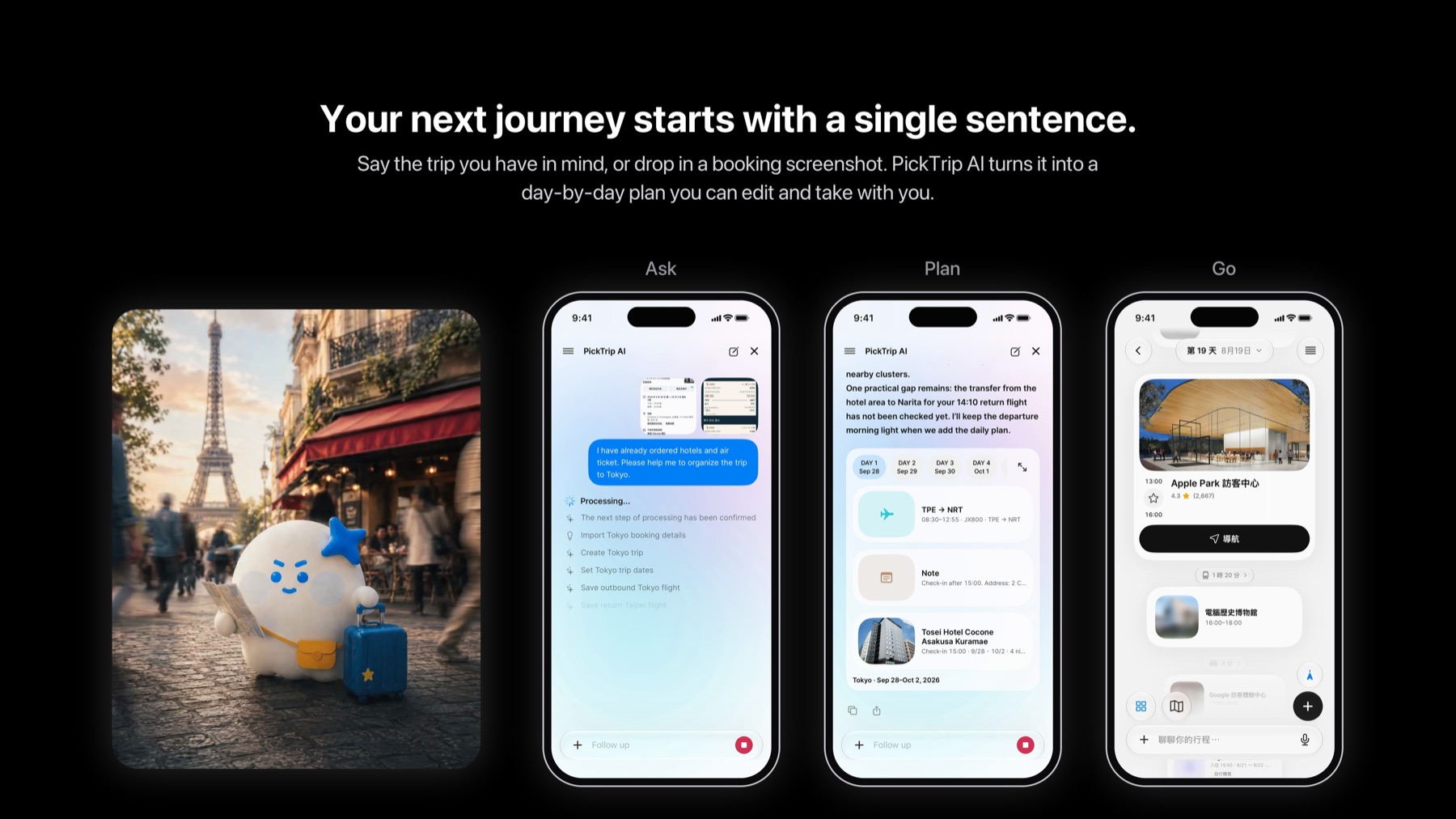
After this summer, we stopped PickTrip.
It wasn't a sudden decision. My partner Eric and I talked it over many times and finally set a deadline together: if by that day we still couldn't see a reason to keep going, we would end it. The deadline kept getting pushed back, but in the end we stuck to it and stopped.
This summer, talking with a senior figure in the travel industry, I asked a question I couldn't quite put into words myself: this doesn't seem like something that succeeds just because you persist — so what metrics, what signs, should I actually look at to know whether to keep going? This post is my attempt to answer that question.
What PickTrip was
PickTrip set out to fix the mess of a group planning a trip together: inspiration saved on Xiaohongshu and Instagram, places in Google Maps lists, discussion in LINE groups, and hotels, flights and tickets spread across several websites. We wanted to bring all of it into one itinerary that several people could edit, with an AI you could talk to, and bookings you could complete right inside the trip.
In one sentence: "make it easier for a group of people to complete a good trip together." That sentence never changed from start to finish. What changed was how we tried to do it.
Thinking "complete" meant different
Our first idea was simple: a trip has a before, a during and an after, and to offer an experience different from everyone else, we had to cover the whole path. So we built AI planning, an itinerary editor, group collaboration, maps, hotels, flights, tickets, eSIMs, notes, to-dos, even post-trip vlog sharing.
In the end we built all of it, but none of it was excellent. The experience was connected, but the details slipped through. With so few people, maintaining that many entry points and ways of editing — by AI, by hand, by importing data — cost far too much. The most common pattern was: add a feature and an old one breaks; fix one and another breaks.
At the end of June we listed the AI planner's problems: a small edit could wipe out the whole itinerary, changing five days to seven produced fourteen, and travel times came out at sixteen hours. None of these could be solved by "adding one more feature."
Turning point one: stop adding features
In a meeting at the end of June, we changed July's goal to this: no new features at all, only fix what already existed, and find our first real test users. The meeting notes put it this way: the biggest problem right now isn't too few features, it's that the existing ones aren't stable enough for real users.
The principle I gave myself then was "usable first, then easy to use." Whether a user can actually finish one task matters more than how many features we have.
Turning point two: reselling travel isn't a business
In July we started doing the maths properly. The margin on reselling hotels and tickets was under 5%; after payment fees and tax there was almost nothing left, not even enough to reliably cover the cost of running our own AI. In our first session with a mentor from Colatour (可樂旅遊), he was blunt: if you try to compete with the big booking platforms on price, you'll lose.
In mid-July we took a demo to a meeting with Mr. Ma (馬總) of Colatour, and that day the AI happened not to work. Drawing on more than twenty years in the travel industry, he gave us a lot of advice: pick one clear target user and one clear highlight; travel agencies already deliver itineraries well enough by PDF and email, so to get them to switch tools you have to genuinely cut their work or their complaints; and the biggest threat is actually Google — if it really wanted to do this, the companies building travel components would fall one by one.
That night the team discussed, seriously and for the first time, whether to keep going with PickTrip at all. We didn't reach a conclusion. We decided to prove one thing first: could PickTrip reliably carry one real trip from start to finish?
San Francisco: rethinking "fast"
In August I took PickTrip to San Francisco for a month, going to all kinds of AI and startup events and talking with founders, people in the travel industry, and people building AI products. The biggest takeaway wasn't technology; it was a way of working.
First, what "fast" means. I used to think fast meant building a product in a few months. There, many people build something in a week, validate it the next week, and decide after two weeks whether to keep going. After talking with Colin John, founder of Fellow Trip, I saw clearly: don't wait for the App Store, don't wait for the product to be polished — put it in users' hands now. Our development cycle had been too long, and not mainly because of technical skill: the scope was too big, our bar for "finished" was too high, and we started validating too late.
Second, building in public. People there often spend more time talking about what they're building than building it: going to events, telling people what they're working on, getting feedback, being introduced to the next person. Many products even start with lots of conversations with customers, and get sold, before they're built. The line that stayed with me most: how you sell a product matters more than how you build it.
Third, choosing the problem. Quite a few people felt travel isn't a good problem to pick: the market is mature and the frequency is low — people travel two or three times a year, so retention can hardly pay back what it costs to acquire a user. At the same time, you can see AI travel startups raising real money, such as a service that makes booking a flight as easy as calling an Uber. What they have in common isn't a bigger vision; it's taking one experience all the way.
Still, not every product should charge ahead at the same speed. Travel has very little room for error: if something you sold goes wrong, the user may be abroad with the whole trip thrown off. So for us, fast should mean "validating fast," not "rolling the product out to a big market fast."
Back in Taiwan, actually selling
Late in the summer we made a decision: lock most features and keep only the itinerary editor, the trip list, hotels, flights and eSIMs, pausing vlogs, small tools and sharing. Hotels became the main way in: get finding and booking a hotel right first, then bring people into the itinerary after they book.
Rather than advertising to the public straight away, we started by partnering with a few groups. A community of about three thousand members put our booking entry inside their product, and we supplied the travel prizes for their community events. Another club that takes its members on trips used our interactive map and itinerary to organise group travel. The two gave us complementary data — one leaning towards purchases, the other towards use during the trip. Over this period we brought in about NT$150,000 in bookings.
Through this real use, we also came to understand the in-trip product differently. At first the editor was the core, built to make changing a trip easy. Later we found that what matters most during a trip isn't editing quickly but looking things up quickly: navigating to the next place right away, getting back to the hotel in one tap, seeing the information you need the moment you open the app. The other thing is questions in the moment — can the AI know where you are and give you the best answer?
In our summer review with Mr. Ma in early September, he pointed out a few things: our core user still wasn't clearly defined; the plan kept slipping, and that in itself was a big problem; and we should set deadlines and financial limits instead of waiting until the product felt "stable" before facing the market. He also said many startups die because they imagine lots of features consumers would use, and in the end lose because nobody knows they exist.
Why we stopped
Looking back, PickTrip didn't fail on one particular day. It was more the sum of a string of "let's give it a bit more time": the features a bit more fixed, a few more users, the direction a bit clearer. Every delay had a reason, but rarely was it because we had seen new evidence.
So what Eric and I finally did wasn't "giving up after failing" but cutting our losses: admitting, before putting in more time and money, that with the resources we had, this problem was unlikely to grow into what we had imagined. More than anything about the product itself, that was the hardest and most important decision of these two years.
If I did it again
- Write down the stop-loss conditions at the start. The deadline, how much you can put in, and what signals you need to see to continue. Once it's written down, don't push it back lightly.
- Validate one thing at a time. The vision can be complete, but each experiment should test only one path.
- Talk to people and sell first, then build. Before the product is finished, you should already know who will use it and who will pay.
- Speed is learning speed. Not how many features you ship in a few months, but how quickly you find out where you're wrong.
- The problem itself needs validating too. Does it hurt enough, will anyone pay to have it solved, and would a big platform swallow it the moment it moved?
Persistence alone doesn't make it work
Back to the question I started with: what should you look at to know whether to keep going? My answer now is that persistence itself isn't a metric. The real signals are whether people still use the product and come back when we're not pushing it; whether anyone is willing to pay; and, each time we decide to delay, whether we can say what new evidence we have since the last time. If none of those can be answered, more effort only pushes back the moment you cut your losses.
PickTrip has stopped, but what these two years left behind is still here: how to shrink a problem that's too big, how to fix a product together with real users, how to let feedback from the market set the direction, and how to stop at the right time. These come with me into whatever I work on next.