
2025 · 01Musashino Art University
[Musashino Art University] New Year's shrine visit, graduation shows and Ryuichi Sakamoto
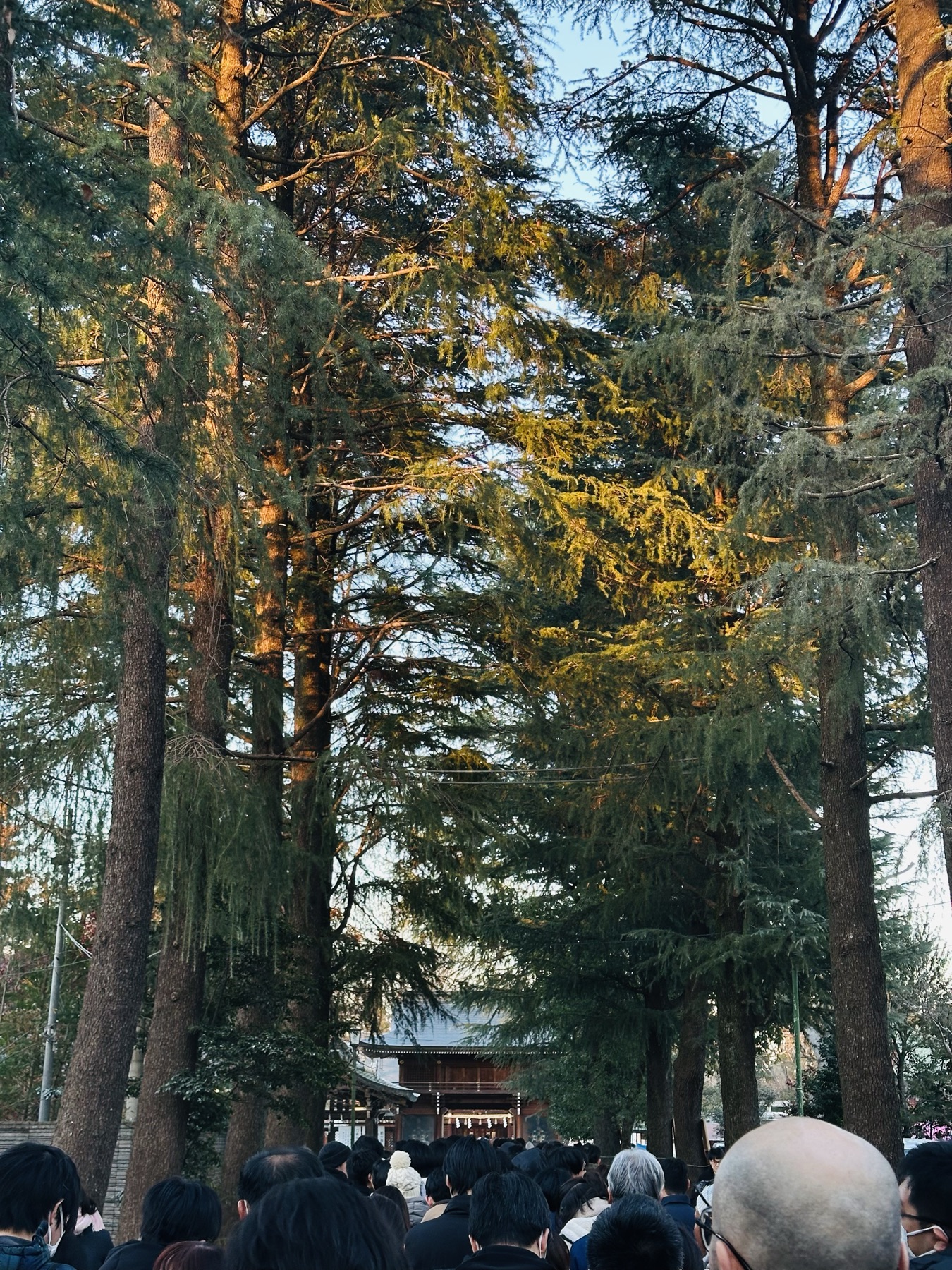
It’s 2025, and this is my first New Year in Japan. Over the holiday the whole city slowed down: many shops closed and the streets went quiet, a sharp contrast to the usual rush of everyday life.
Following Japanese New Year tradition, I went to a shrine with friends for hatsumode (はつもうで, the first shrine visit of the year). It was my first time properly taking part in this ritual. The line in front of the shrine was so long that the wait alone took almost three hours. Listening to people toss in their coins, ring the bell, and put their hands together to make a wish, I got a feel for how New Year is celebrated in Japan.
Presentation
Even though it was winter break, there was still a presentation for graduate students this month: we had to present our research progress in front of all the professors and get feedback from different angles. My presentation followed on from my earlier work visualizing light and sound in the city. The piece is an attempt to record the light and sound along a street and turn them into a series of “flowing impression color swatches.” These swatches are not only a concrete rendering of environmental elements but also an abstract expression of a street’s atmosphere. In the critique, though, one professor raised a key question: does a work like this bring any new value or discovery?
He pointed out that although the work successfully reproduces the perceived impression of a particular area, it matches the impressions people already have of those places, as in “yes, that’s what Shibuya is like,” so it lacks any element of surprise. He suggested I think about adjusting the conditions under which I record, so the work can bring out subtle changes in the environment. That might create more unexpected contrasts and, in turn, a new way of looking.
Graduation Shows
This month was graduation show season. Besides visiting the shows, I also helped the senior students build their exhibition space. Unlike my experience back in Taiwan, here almost everything, from setting up the venue to the finishing details, is done by the students themselves. Even for the wooden partition walls, we bought the lumber, carried it back, and cut and installed it ourselves. It really drove home that besides making the work, physical stamina and practical skills matter a lot too.
I also visited Musashino Art University’s graduation show. Every department turned its own building into an exhibition space, so there were different kinds of work around every corner, and students from the performing arts department were even giving live performances all over campus. The whole campus felt like one big art festival.
A few works left a strong impression on me. One explored “dust,” turning these seemingly insignificant particles into a spectacular cosmic scene through a light-and-shadow installation, making you rethink the traces of time and space. Another revolved around insects, imagining that insects had learned to mimic man-made objects in order to survive. There was also a work on Japan’s receipt culture, which drew shop staff, customers, goods, and scenes onto real receipts, turning them into an “urban picture book.”
Explores the possibility of insects adapting to man-made environments.
It imagines insects that have learned to mimic man-made objects in order to survive.
“Where do we come from? What are we? Where are we going?”
An exploration of the forms and growth of living things and what different species have in common.
“Where do we come from? What are we? Where are we going?”
An exploration of the forms and growth of living things and what different species have in common.
A receipt is not just a record of a transaction but also a shop’s “handwritten history.”
Shop staff, customers, goods, and scenes are drawn onto real receipts, turning them into an “urban picture book.”
The Ryuichi Sakamoto Exhibition
One of the exhibitions that impressed me most this month was the Ryuichi Sakamoto exhibition. His work goes beyond music: he uses sound as a medium to converse with space, time, and the environment, letting us perceive the presence of sound in a completely new way.
One work I really liked was “IS YOUR TIME,” a piano destroyed by the tsunami in the March 11, 2011 earthquake. Sakamoto saw it as “a piano tuned by nature,” and by playing the damaged piano he sought to feel nature’s indifference and human fragility.
Another work that stayed with me was “LIFE–fluid, invisible, inaudible...,” made up of many water tanks suspended in the air. Images projected into the tanks interweave with the light and shadow of the mist, creating a fluid, dreamlike atmosphere, and as you walk through it you feel as if you’ve stepped into a world beyond time and space.
It looks back on major 20th-century themes such as “war and revolution” and “science and technology,” trying to portray “things that are fluid, invisible, and inaudible” and exploring the boundary between the perceptible and the imperceptible, ultimately using mist as its medium. Beyond its strong visual impact, the historical footage in each tank and the sound of walkie-talkies created an atmosphere as if we were peeking into the past.
This exhibition got me thinking about how to add layers of “time” and “perception” to design: not only a visual presentation, but letting viewers experience a work through multiple senses and so form a deeper connection with it.
Summary
In January, all these exhibitions and discussions gave me a lot of new inspiration.
Going forward, I want to deepen my own work and tie the “meaning” and the “method” of each piece more closely together. I also hope to find ways of presenting work that create deeper interaction with viewers, so a piece is not just something static but becomes an experience you can sense.