
2025 · 05Musashino Art University
[Musashino Art University] A May spent running to keep up
If I had to describe this month in one phrase, it would be “always being chased.”
Every week, every class had tasks and milestones to push forward, and on top of that I was about to present my Seminar (Design Theory Practicum) project, which spans both semesters, in early June. That made May's schedule especially tight. I wanted every assignment to be 100% finished, but time and energy are limited, so I kept refining my schedule and making trade-offs.
Interface Design
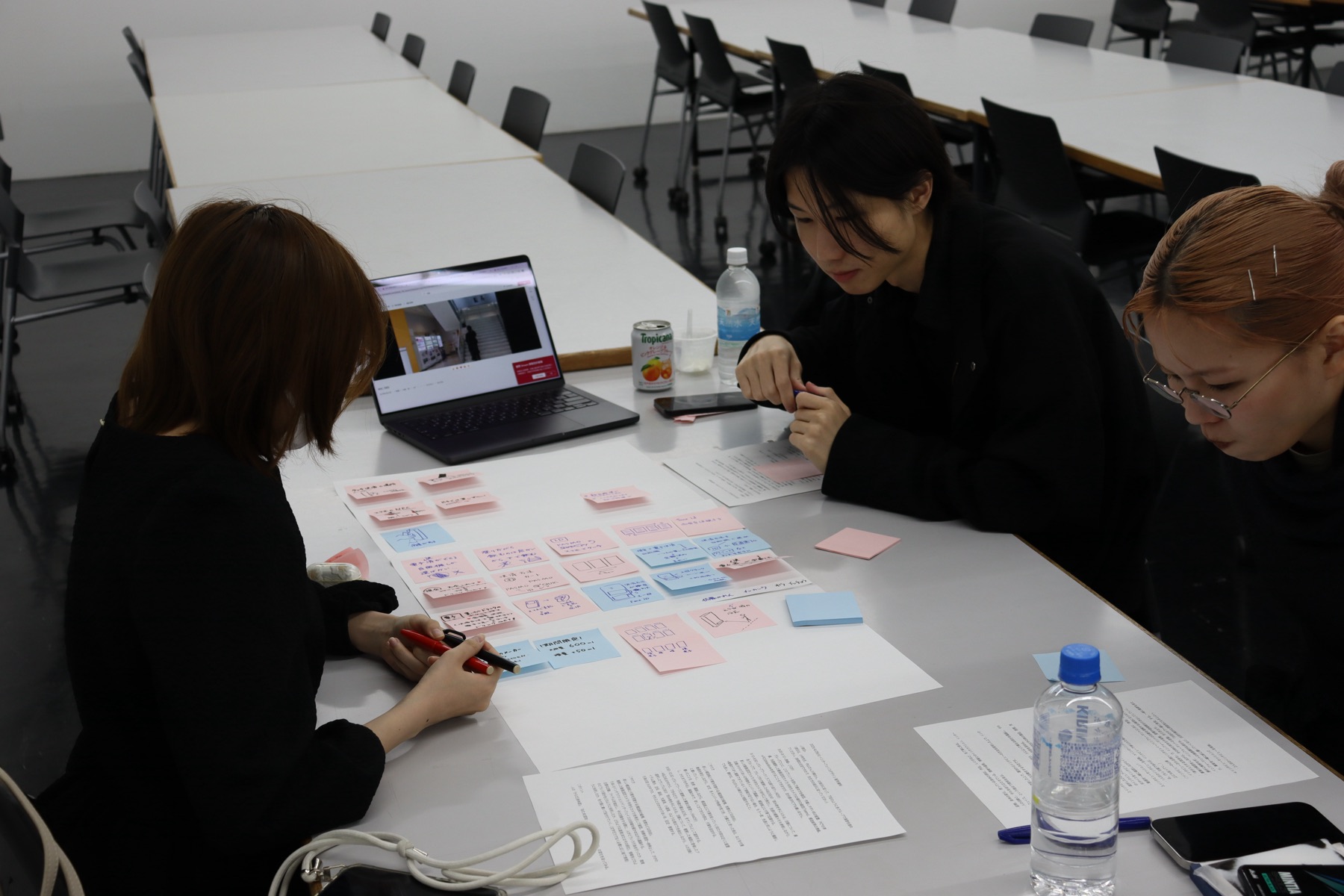
At the start of Interface Design (インタフェイスデザイン), the professor asked us to observe an everyday behavior: “how people get a drink.” Not just describing the behavior itself, but digging into how people, in the process of buying a drink, interact with their environment, information, tools, and even other people.
Our subjects were Sato-san and Wang-san. On the surface their processes looked similar—both bought a drink with electronic payment—but their actual experiences differed in key ways. Sato-san looked for a vending machine that accepted e-payment, checked the drink options, and paid by phone without a hitch; the whole process was simple and smooth. Wang-san, on the other hand, hit one obstacle after another: the main card failed, the backup card didn't respond, and the payment finally went through with PASMO on an Apple Watch. The problem was solved in the end, but the whole process took a long time and came with obvious stress.
We recorded the details of the behavior through on-site observation and video, then ran semi-structured interviews to understand the thoughts and feelings behind it. After organizing the material, we made a journey map. Using the categories “environment, tools, information, other people, thoughts, emotions, context,” we broke a single action down into layers of interaction and psychological states.
We found that even though users have several payment options, when one of them fails, the lack of clear error messages and guidance toward alternatives easily leaves people confused and anxious. In our visualization we put special emphasis on these “hidden behaviors” and “emotional swings.” Beyond analyzing the behavior, we also used a line graph to chart the rise and fall of stress and satisfaction, so viewers could grasp the user's state of mind more intuitively. We dug into how users felt at each touchpoint: whether they felt reassured, whether things went smoothly, whether they felt understood.
Product Environment Design
In Product Environment Design (Design Practicum Ig: Product Environment), the professor asked us to start from a material of our own choosing, intervene in it with one technique (cutting, burning, and so on), and observe what happens. I ended up working with noodles, and found that as they burned, each noodle curled in its own way.
How each noodle bends depends on its thickness and moisture content, and even on the airflow and the angle of burning at that moment.
Next, I tried packing the noodles tightly in a chain and lighting them from one end: each noodle was affected by the one before it and in turn affected the next. A chain reaction ran through them, and the way they influenced each other produced different effects.
This class made me rethink the relationship between “material” and “intervention.” Making things isn't only about controlling materials; it's also about observing the process of change.
Visual Communication
The second assignment in Visual Communication (ヴィジュアルコミュニケーション) was “yatai (street stalls) and mobile vending services.” The professor asked us to start by imagining a mobile service that could enrich society and carry it through a complete design process: naming, logo design, model-making, and visualizing how it would be introduced into society. The emphasis was on the full chain of “concept → visualization → physical testing → social implementation.”
In class, the professor reminded us: “AI is a mirror that reflects the depth of your questions. It isn't about operating the technology; what AI gives you depends on the questions you ask.” He also kept stressing the purity of the logo and the meaning of the name: when a mobile vehicle enters public spaces like streets, whether its identity system can be quickly understood and trusted is what makes or breaks the whole project.
Our group's concept was Cinderella: a mobile fashion service combining clothing storage, rental, delivery, and a transformation experience. People's closets today are always taken up by clothes they rarely wear, yet when they actually need an outfit, they can't find the right one. Cinderella sets out to create a “magic closet,” where every piece of clothing is properly stored and shared, and appears right when it's needed.
Our system has two main pillars:
Clothing storage and sharing: Users can store important but rarely worn clothes (formal wear, cosplay, seasonal clothing) in our “cloud closet,” and use the app to lend them to friends or rent them out publicly for profit. Storage isn't just keeping things; it's a redesign of how resources are shared.
Rental and transformation: The app has built-in AI try-on and full-outfit recommendations, covering clothes, accessories, hair, and makeup in one go. Delivery is flexible too: besides home delivery, you can book the “fashion bus” and try on and change on your commute or at an event. The bus also offers extras like hair and makeup, so the whole experience is like a fashion salon on the move.
In the critique, the professor said our concept had a clear direction and great potential, but needed strengthening in two areas: the actual logistics design and operational flow, and the real situations in which users come into contact with the service. The visuals and the name could be refined separately and didn't need to be finalized in one go. He also said that if we could lay out the overall service logic and business model more clearly, it would be far more convincing.
Seminar
This class will be my final presentation at Musashino Art University and the core project of the seminar that spans both semesters; the presentation is planned for next month. With less than a month left, I have to finish all the content and the exhibition design in very little time. Right now I'm shooting material and experimenting with ways to display it.
Since my work is essentially a 3D motion graphics system, I want to present it as a hologram, so viewers can directly experience, in space, the visual language formed by this constantly shifting light and sound data. To make this happen, I'm trying out Pepper's Ghost to create a floating effect and testing how various transparent reflective materials respond.