
2025 · 06Musashino Art University
[Musashino Art University] All-nighters for the exhibition, then Expo 2025
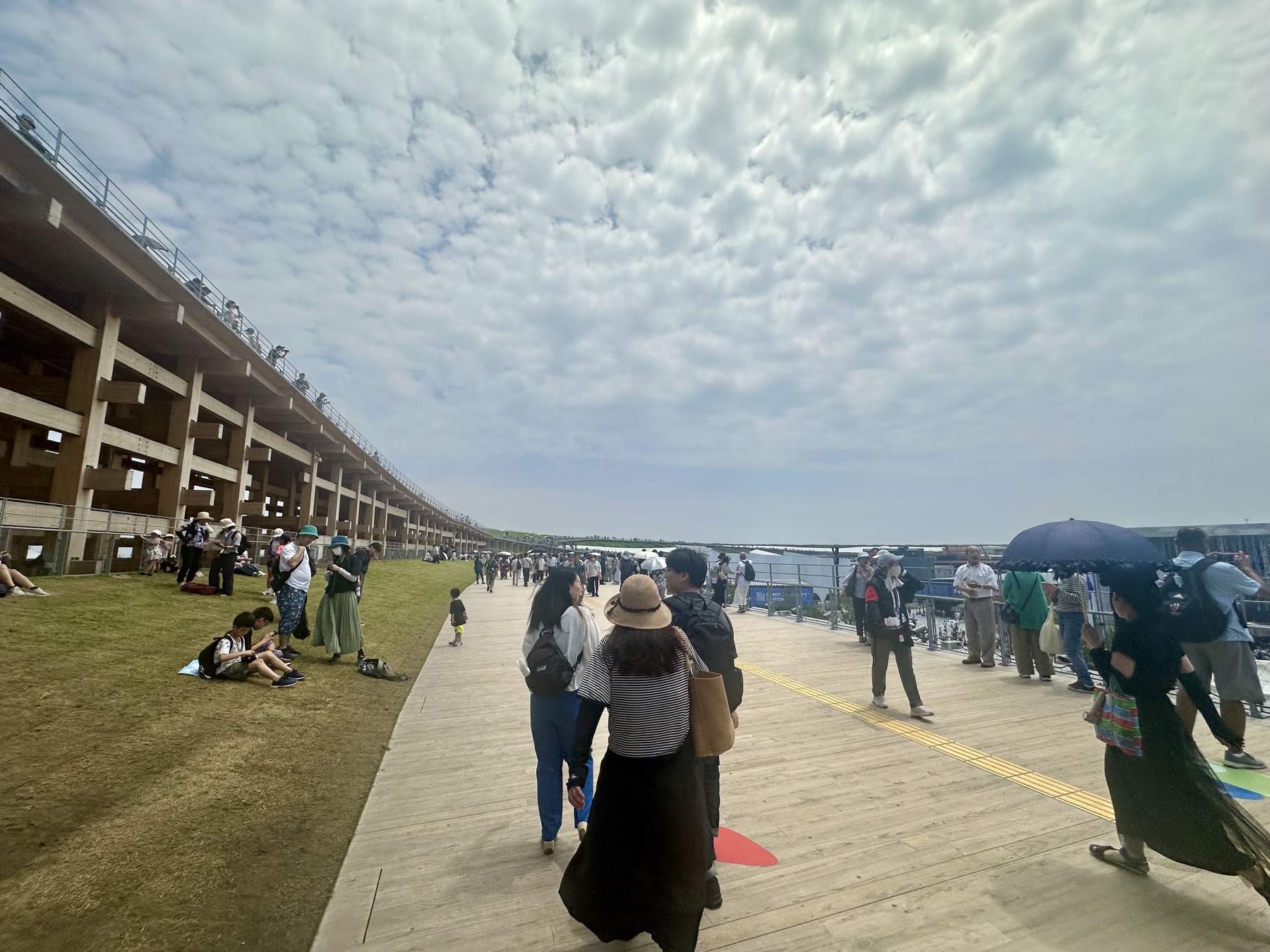
This June was especially dramatic for me. The first half of the month was filled with final presentations and exhibition prep. To show my work properly, I even stayed up all night a few times, testing and fixing over and over, and my anxiety peaked at the very moment the exhibition setup was finally done. After the presentation I finally got a short break, something I hadn't had in a long time, and went straight to Osaka to see Expo 2025 Osaka, which I'd been looking forward to for ages. Then I went on to Kyoto to enjoy the slow pace of the old capital.
Product Environment Design
In Product Environment Design (Design Practicum Ig: Product Environment), we started our second assignment: “Mass-producing difference” (「違い」の量産). It asked us to start from a product's function, choose any material, and conceive and make a range of products that differ from one another.
I chose the notebook as my subject and tried to start from “the essence of writing” to rethink the notebook's form and how we use it. I picked notebooks because they seem ordinary, yet they hold a lot of room for behavior and personalization, especially in page turning, binding, and the writing surface.
We had to bring proposals to every class. At first I came up with many of them, varying the material, the way of writing, and the visual and spatial form. I hoped these differences in form would lead users to new movements, rhythms, and sensations when writing.
Binding detail of the ring notebook proposal: the spiral coils and pages fan out radially, exploring shifts in rhythm and direction between writing and turning pages.
The professor reminded me that I needed to distinguish more clearly between “a change in form” and “an essential difference.” Many of the proposals felt fresh in shape or feel, but if they didn't change the act of writing itself, they easily ended up as surface-level variations. The professor also pointed out that some of the designs were too forceful toward the user: interesting, but possibly lacking in enjoyment and practicality. Design isn't only an expression of creativity; it's an invitation that makes people want to use something.
Visual Communication
This month in Visual Communication (ヴィジュアルコミュニケーション), I took “Fukumo,” a digital clothing management and rental service, as my theme and began developing a visual design system that could explain the service concept, the brand image, and the user experience.
Working from image style, character icons, color choices, typography, and usage scenarios, we tried to present the functional side of the service (automated delivery, cloud storage for clothes, the app, and so on) in a consistent visual language.
For the interface and service scenarios, the professor encouraged us to build a visual system that could “tell a story” across every step—automated warehouse management, garment packaging, using the app, and unmanned delivery—rather than piling up individual images. In future services, visual design plays the role of “connecting users with functions” and “communicating the logic of complex systems”; it's part of design strategy, not just an aesthetic expression.
The professor also encouraged me to think further about market strategy, such as brand partnerships and a closed cloud-closet business model, to build a more competitive ecosystem. So while thinking about the design, we also started to touch on business positioning and product integration.
Seminar
In Seminar (Design Theory Practicum), I completed my final work of the semester: Textures of Streets. It's a visualization that brings together data, the senses, and the experience of the city, trying to translate the everyday flows of sound and light that are hard to capture into a moving terrain where you can “see time and space.”
My work visualizes the light and sound of the city. Living in a city, we pass through streets every day, our bodies and senses constantly taking in flows of sound and light, yet these fleeting perceptions are often ignored and forgotten. By translating the sound and light data of everyday streets into visible textures and rhythms, the work builds a digital terrain that has both time and space in it.
For the project, I chose different neighborhoods in different parts of Japan, visited them in person, and recorded audio and video, capturing sensory data such as sound intensity, types of ambient sound, changes in light, and color composition. This data was then organized, analyzed, and translated into images and color fluctuations, forming a series of time-based terrain maps.
In the exhibition space I set up a hologram device, so viewers could watch the terrain being generated through 3D projection while hearing the actual sounds of the streets and sensing the visual rhythm created by the changing light. With this installation I wasn't just making images; I was building a space to be “experienced.” Viewers could intuitively compare the sound-and-light character of different neighborhoods, and also reconsider what their own senses take in every day in the city.
Looking Back
Writing this now, I have a feeling that's hard to put into words: looking back, I've somehow already reached the second-to-last post. One more, and it's the grand finale.
With the final Seminar presentation done, the core work of my year here has come to a close. Looking back on the process, from the first ideas and discussions with the professor to the final exhibition, it was full of challenges, but it also let me truly feel how much I've grown and gained during my time studying abroad.
Finishing this main work also reminds me that my days studying abroad are coming to an end. There's still a little over a month before the semester actually ends, and I still need to focus on polishing work for my other classes, but this feeling of slowly nearing the end leaves me a little wistful. Because of that, I treasure my remaining time in Japan all the more. Besides finishing my work, I also want to get out and see and experience more of what I haven't yet.