
2025 · 10Musashino Art University
[Musashino Art University] Looking back: the everyday is the ability to keep observing anew
This post is adapted from a talk I gave after my year at Musashino Art University. The theme was "the everyday." Rather than break it into topics, I wanted to follow the timeline of that year in Japan, from the day I arrived to the day I left, and look at how I rebuilt, re-observed and re-experienced my own everyday life.
Arriving: rebuilding a life and an identity
I think the everyday often begins by leaving the everyday behind. The first thing I did in Japan was paperwork: student ID, resident registration, residence card, driving licence. Each one felt like rebuilding myself. Even my name changed — from Chinese to English to Japanese. Being renamed made me realise for the first time that an identity can be reconstructed.
At the same time I was setting up a new room. To me, building a room is like building an everyday life: you start from an empty space and add things bit by bit, and little by little the life in it starts to carry your traces.
First term: a new campus, a new way to learn
Walking into Musashino Art University for the first time, I expected a big campus. It's actually small and warm, and at that size people get to know each other easily. Graduate classes came in two kinds: group courses much like in Taiwan, with team assignments, and discussions with professors — one-on-one or small-group seminars, which were really the main way we learned.
What struck me was how free the students were. They didn't only see their own supervisor; they'd go to other professors' studios to ask for advice too. The whole graduate school felt like an open learning community.
Making work out of time
In my first term I took an unusual class called Time Axis Design. The brief was simply to make the audience feel time. The teacher didn't restrict the medium at all — animation, posters, interactive installations, sound — anything, as long as people could feel time.
I wanted to work with typing. I type slowly, and I often wondered whether how fast someone types reveals the rhythm of their thinking. So I built a chat platform that, based on the gaps and speed between each character, lets you see the other person's pauses as they think — as if text could breathe. That class taught me that time isn't the numbers on a clock; it's the rhythm between people.
The days without a direction
Alongside classes I was developing my own project. That was the hardest stretch of the term, because my professor gave me no topic — only "go and observe; find what you want to make in everyday life." It sounds simple and is very hard. Without a brief I felt more lost: how do you find something worth making into a work in a life that happens every day?
So I kept trying and experimenting, with ideas about signatures, light and shadow, the city — and all of them came from how I was living then. Signatures, because in my first weeks I was signing things every day: documents, a bank account, my residence card. A signature then wasn't just a name; it was a sign of being confirmed and accepted, linking a person to institutions and to other people.
The city came from daily life. I walked and rode trains a lot, through all kinds of streets — loud and quiet, bright and dim. They belonged to the same city, yet each had its own expression. I began to wonder whether design could make the difference in atmosphere between streets visible. Those feelings were real, but hard to put into words.
The art festival
The liveliest event of the term was the art festival. The whole campus turned into a small Disneyland — stalls, a parade, stage shows, with professors joining in alongside students. That free, lively atmosphere made me feel that Japanese universities really fold "life" into school. It was the first time I felt I wasn't just an exchange student, but part of the school.
A four-month winter break
Then came winter break — an outrageous one, from December to almost April. I drove around: Karuizawa, Fukuoka, shrine visits, skiing, and working on projects in cafés with my laptop.
During that time I started thinking about what the everyday means: when life has no classes or tasks, how do you make it feel meaningful? Maybe the answer is to notice the small, everyday things — and to record them.
Spring, starting again
The first day of the spring term was romantic, cherry blossoms everywhere. For Japanese people it's the season of beginnings; for me it felt more like beginning again. A new group of students arrived and I built my relationships over once more. That rotation felt like the seasons: each restart means adapting and observing all over again.
Design isn't creating; it's observing
That term I took several classes I loved. One used matryoshka dolls, treating the act of opening as a metaphor for design thinking. My theme was how people get wrapped: from inside to outside, from nature to society, we keep putting on layer after layer. Opening the dolls one by one became a way to show the relationship between identity and socialisation.
Another was the Product Environment design practicum, which overturned what I thought product design was. It wasn't about function or form, only observation and intervention. We each chose a material and intervened in it in different ways. Some folded paper, some cut wood; I chose burning noodles — yes, instant-noodle noodles. Depending on the angle, the burning noodles curled into all kinds of organic shapes. At that moment the experiment felt like design in miniature: design isn't creating; it's observing a phenomenon as it happens.
From there I built a series of notebook experiments: changing only the binding ring changed how people used the notebook. I made many versions and saw wonderfully strange ideas from classmates — a ring you can blow bubbles through, a candle that becomes a bookmark once it burns down. That class showed me how alive materials can be.
The light and sound of streets
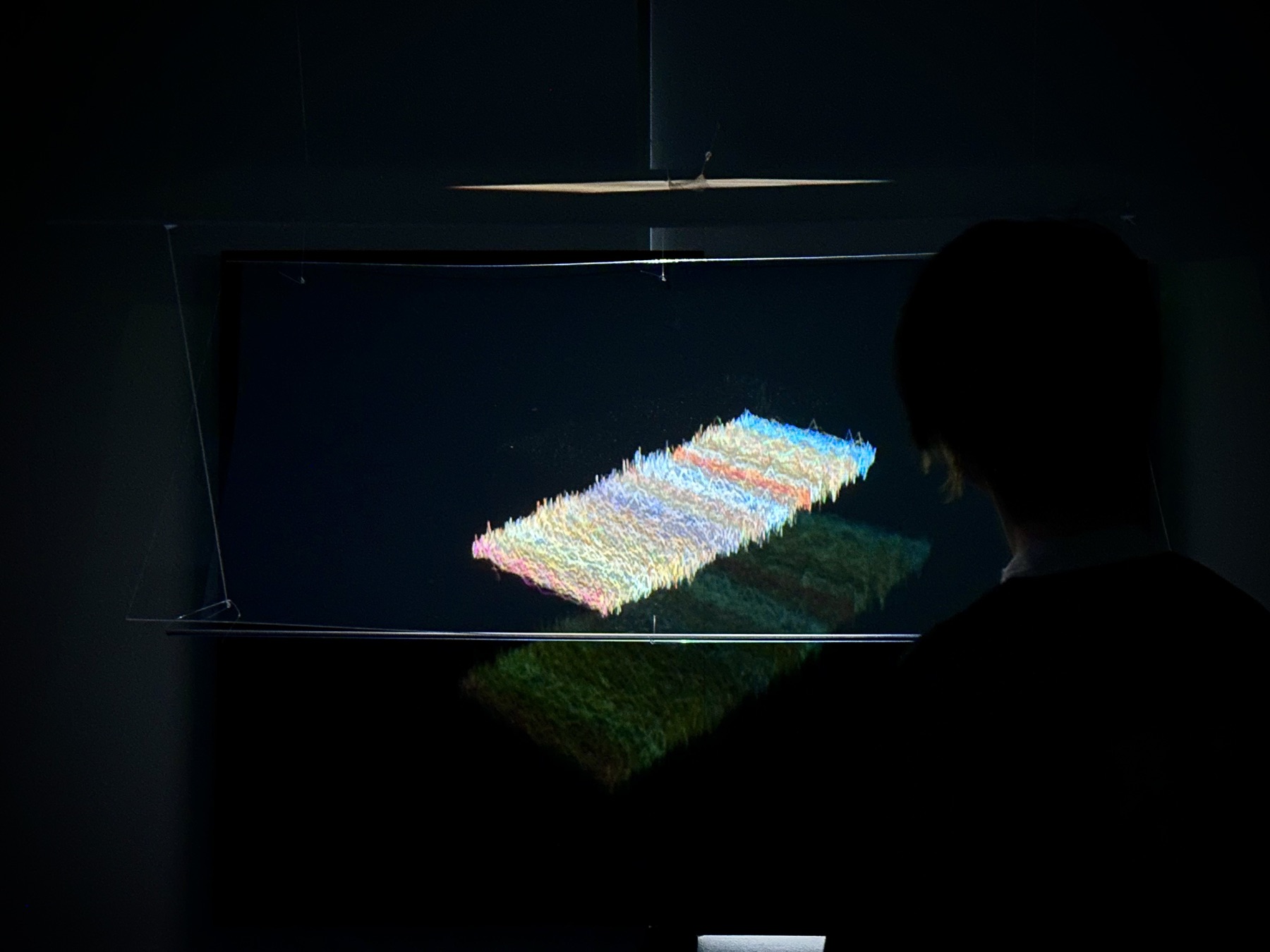
My main project became The Light and Sound of Streets. I walked many streets — Shibuya, Yokohama, Tokyo Station, Kabukicho — recording each one's sound and images, then turned them with code into topographic maps of light, each one capturing a street's rhythm and energy. I showed them as a floating projection so visitors could "hear light and see sound" in the space, and hopefully see again the city life that habit had drowned out.
Summer, and goodbye
Summer in Japan is full of festivals — fireworks, beach events, concerts. By then I knew I'd soon be going back to Taiwan, so that summer had a romance of farewell. I went to the coast at Izu with friends, watched fireworks and drank beer. In that moment I felt I had truly become part of everyday life there.
The everyday is the ability to keep observing anew
Our professors often told us: we don't create new things out of nothing. Through observation and experiment, we find what already exists and resonates with people, then design from our own experience and understanding.
I think that maps exactly onto the everyday. We're often too used to our own lives — as the Chinese saying goes, you can't see the true face of the mountain when you're standing on it. Stuck in our own rhythm, we can't see what our everyday actually looks like. So the first step to finding material for design in life is to step out of your everyday. Only by leaving a familiar structure do you notice details you missed before.
Stepping out doesn't have to mean moving house or going abroad. It can be taking a different way home, a different breakfast place, a different place to work — living the same world from another angle. Two things matter most in the process. One is experimenting: daring to try and to make, because only by acting do you discover something new. The other is observing: finding, in small changes, the details you used to overlook.